

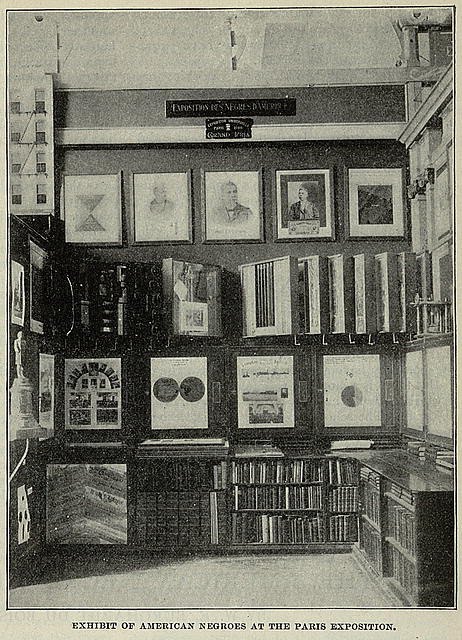
The stunning charts you see here were hand drawn and colored at the turn of the 19th century, by Sociology students at Atlanta University (now Clark Atlanta University). Their professor at the time, African American activist W.E.B. Du Bois, was organizing the upcoming “American Negro” exhibit for the 1900 Exposition Universelle in Paris.
Over 60 charts and maps, along with specially commissioned photographs were prepared for The Georgia Negro Exhibit, which was part of the larger display. Only three of these infographics are available in color from the Library of Congress. Click on them to view them larger. There are black and white reproductions of the entire group (see selection below), at the extensive online archive created by Professor Eugene F. Provenzo, Jr., of the University of Miami. There, you will find an enormous amount of information and visual material pertaining to this important historic exhibit.


The following excerpts from Professor Provenzo’s site offer more detail about the information graphics.
Du Boise described the project in his autobiography:
In 1900 came a significant occurrence which not until lately have I set in its proper place in my life. I had been for over nine years studying the American Negro problem. The result had been significant because of its unusual nature and not for its positive accomplishment. I wanted to set down its aim and method in some outstanding way which would bring my work to the notice of the thinking world. The great World's Fair at Paris was being planned and I thought I might put my findings into plans, charts and figures, so one might see what we were trying to accomplish. I got a couple of my best students and put a series of facts into charts: the size and growth of the Negro American group; its division by age and sex; its distribution, education and occupations; its books and periodicals. We made a most interesting set of drawings, limned on pasteboard cards about a yard square and mounted on a number of moveable standards.
From an official report provided to the Exposition:
Finally should be mentioned the results of the special studies carried out by Professor Du Bois. These consisted of a series of charts showing the condition of the colored race in the State of Georgia. This State was selected as being the one with the largest negro population. These charts showed first the general distribution of the negro race in all parts of the world, then the distribution in the United States by States, and finally the conditions in Georgia in great detail. These latter charts indicated the growth of the negro population in the State by decades; its relative increase in comparison with that of the white race; migration to and from the State; the distribution of the negroes according to age, sex, and conjugal condition; the occupations of the negroes; the number who could read and write; the value of the property owned by negroes; the number of acres owned by them or being cultivated by them as owners or tenants; the value of farm implements, horses, and stock owned, etc.
The variety and inventiveness of charting devices used, is quite impressive, especially for undergraduate Sociology students in 1900. Unfortunately, the quality of reproduction is not very good. I’ve uploaded the files here, as I found them. Some will enlarge when clicked, and some won’t. Once again, to view the entire series go here.


