Popular Post
Showing posts with label Brian Eno. Show all posts

A Brief History of Ambient


A Brief History of Ambient Vol 1 - Disc One
A Brief History of Ambient Vol 2 - Disc Two

A bloody stomper of a comp. A comp stomper.

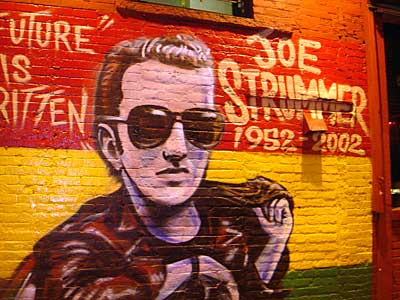
There is a well-known graffiti homage to Joe Strummer in the East Village, which you have undoubtedly passed by in a state of mild distraction, during one of your many boozy, late night perambulations, the sort that ends with the impromptu ingestion of fried dough and a gnawing predilection for dialing individuals with whom, all things considered, it is probably best you maintain no further contact. You probably should just go ahead and delete their number now, while you read this, presumably at your office, and presumably sober, during one of your daily cookie breaks. [Pret a Manger is good]. Further contact, you know in the back of your mind, will lead only to further sorrow, and quite possibly a trip to the men's health clinic.

The image depicts the Clash singer wearing sunglasses, his jacket thrown over his shoulder, accentuated only with a phrase which became one of the band's many unofficial slogans, "The Future Is Unwritten."


This shouldn't be understood to say that this is a property belonging only to the time of what has not yet taken place. Because the past is also unwritten: the steady, inexorable course of present time, in all of history's incalculable twists and inversions, is constantly rewriting the past, making the hidden sonics of its concealed treasures echo in a new key.

Re-engagement with the past is especially fun in the sort of proto-time that we love to go on about at AC, in those heady, experimental open-ended periods of artistic intensity which only retroactively become parts of a movement or can be understood as contributing a genre.

Brian Eno, as every schoolchild knows, is widely credited with coining the term 'ambient music,' and the apocryphal account of the genre's inception involves Eno in an incapacitated state, lying in bed with a broken bone of some sort, listening to a record which had been put on but at an improperly low volume, such that its sonic contents were experienced at the threshold of audibility, wavering in and out of range of the human ear. Like any good materialist, Eno saw this as a new potential to be explored. The musical revolution that followed was a fulfillment as well of Erik Satie's desire to make music "to mingle with the sounds of forks and knives at dinner," rather than something to be consciously, attentively devoured by the audience. Music became wallpaper, became sculpture, became practical, became that most deliciously minor layer of stimulation that cushions you from the harsh opacity of empirical reality.

All your usual suspects are here on this comp, Mr. Fripp, Mr. Eno, Mr. Harold Budd, Mr. Tangerine Dream. Fripp & Eno's acknowledged classic "Evening Star" is here, evidence alone of Mr. Fripp's status as the Eric Clapton of Boring Music. The whole thing is just an epic list of early ethereal compositions and bugged-out melodic drift. Get with it, it wears a beard. Homeless wizards listen to it while doing yoga. Also Harold Budd's piano playing is just sick.

BTW supposedly Eno was as well influenced by a Miles Davis track called "He Loved Him Madly," which is supposed to be some epic ambient jazz dirge tribute to Duke Ellington. Does anyone have this?

Here's a ridiculously cool interview with Eno where he explains the principles behind his "Music for Airports", in which he explains the need for having music tailored for public spaces, how it should be composed so it doesn't interfere with other sounds (human communication, announcements), and so on. Subtitled in Dutch, thank God.
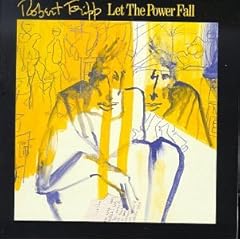

Robert Fripp: Let the Power Fall & Air Structures


Out-of-print 1981 solo album by avant guitar virtuoso Robert Fripp, introduced to me by Maya M.

For the sake of my own and the reader's sanity, those seeking biographical information on this visionary and multifaceted artist are advised to visit a site called "Elephant Talk". Suffice to say that Fripp, who lives among us even now, is well-known for what is called "Frippertronics", the use of a very particular set-up of tape loops and other such equipment in order to transform the solo performance of an electric guitar into an expansive field of soothing ambient vibrations.

This album has garish 80s cover art. This album is also really good, and is definitely up there with top five chill hard records ever. It is also highly effective for promoting serenity of mind in the workplace or any long period of time spent staring at a small electronic screen.

In other words, it serves as a great sonic remedy to Blaise Pascal's aphorism that "all men's miseries derive from not being able to sit in a quiet room alone."

I also had to reflect on what the title meant, and I decided that it maybe refers to the act of musical improvisation. First of all, successful improv means not using power, if by power you mean controlling things and knowing all the time what's going to happen. So the power has to fall or otherwise be deposed. Now the problem with this is, how to depose power without power returning via the deposition. You may think you get out of it, but the getting out of it turns out to be just a really great way to stay in it. Because power isn't just happy being power, it wants to take control of not-power also.

So you want power to fall, but you can't just push it over, you have to find a way to let it fall. But the beauty of this fall, its aesthetic component, isn't when power is lying all gross and smashed on the ground like a dead bird, but, as in Fripp's case, in the gloriously long decline itself, maybe so long that it never ends, which is what this album sounds like, like power falling forever, across infinity.

Let the Power Fall: http://www.divshare.com/download/4536838-359


And additionally, for those already versed, this unofficial 1975 Live Paris bootleg with Brian Eno is made available. A two-disc set, the tracks, which run the gamut of Fripp's officially released studio output together with Eno, are listed only as S 1-4.


Air Structures: http://www.divshare.com/download/4538141-17f

Bowie Biters in the Aftermath


Peter Gabriel - I Don't Remember


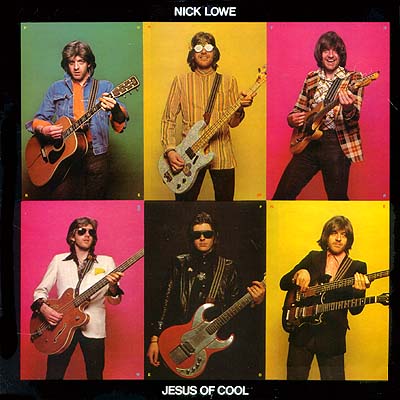
Nick Lowe - I Love the Sound of Breaking Glass


Billy Idol - Hot in the City


William Judd - Shibuya Overdrive


RECENTLY OVER PIZZA a friend expressed the latent fear that she had been born too late. While attending an academic conference featuring several luminaries of 70s radical feminism, my friend felt a melancholic twinge - nowhere could there be found today the same kind of pervasive revolutionary energy, the kind that sweeps the mob together into the movement, the kind that serves as a north star under whose ceaseless light all things gain new contour. She was speaking, it seemed to me, of the problem of the aftermath. Of the fact that after the revolutionary event, life stubbornly insists on inching forward, on outgrowing whatever smooth new cloak we thought we could wrap it in.

It seems as well that one needs more heroic strength in the aftermath than during the time of the event. Anyone can follow the mob up the stairs of the Bastille. Or shoot out those clock towers. Anyone can choose sides. But to keep a lonely vigil once the ecstasies and tumult have quieted, to keep looking for a way forward when there are no more bearded kings to come down from the mountain, their mouths full of prophecy.

This is a big problem for successful artists, what to do after you've hit your peak. The documentary called 'Comedian' is a striking example of this: it follows Seinfeld in the wake of the glory surrounding his massively successful television show, as he trudges onward and returns to the standup circuit, figuring out what to do next.
German note: the name 'Seinfeld', Sein-feld, might be read as 'field of being'. Such is the existential problem of the aftermath - its protagonists wander free in a field of being, lacking orientation.


This artistic aftermath is a big problem for rappers, whose street-tough personas start to appear somewhat ill-fitting once they become 'rappers of a certain age', no longer with chips on their shoulders (they've been brushed off). The aftermath is such a problem for rappers, Dr. Dre went and named his record label after it.

RZA's latest track, 'Can't Stop Me Now', seems to reflect this miasma. Why does RZA need to tell us now, twenty years after 36 Chambers, that we can't stop him? Where does he get the idea that we would want to, or think we could?

RZA - Can't Stop Me Now


In honor of the aftermath we present four songs that gain their strength from the aftermath of David Bowie. The four songs here are particularly indebted to the works of Bowie's Berlin trilogy. "I Don't Remember", from Gabriel's eponymous debut solo record, captures the spare, icey funk and paranoid lyrics, "I Love the Sound of Breaking Glass" serves a condensation of the whole first half of the album 'Low', (noting that one of the songs on this Bowie record is called 'Breaking Glass', and that Nick Low-e's restrained white-boy rhythms distinctly evoke "Sound and Vision"), Billy Idol channels the swaggering posture and flamboyant urban romance, and William Judd jacks in to the ambient eno-produced instrumentals that take up the second halves of 'Low' and 'Heroes'.

Bowie, it should be said, is a bit like Goethe - every new genre he decided to try his hand at, he reinvented. When there's an event, like the Bowie event or the Goethe event, it tends to have traumatic effects for those who come after. Sometimes, those who come after are jilted lovers whose paramours have always-already been gone, who mourn for days they never knew. Other times, they are carefully keeping the way open, preparing for tomorrow, continuing to do the steady, loving labor of the apostle, spreading and pronouncing the word, again and again.

Astro-Tropicalia


Magma - Udu Wudu


It would not be any kind of exaggeration to say that a decent line of critical inquiry can always be opened up by asking a stupid question, a question any fifth grader would know. Critical thinking is, to invoke Jeff Foxworthy's popular show, not smarter than a fifth grader.
For example, it doesn't know the difference between an old thing and a new thing. So it asks again, and when it asks, it's possible for it to find there another understanding than the one commonly shared.
There's at least one another way that historical time, marked by a difference between old and new, can be understood. In a way, we can say that historical time is born in a moment that is not just one moment. This kind is actually several moments at once, it's actually past, present and future, occurring alongside each other in a densely compacted burst. In the history of music, it's an old song that sounds new and fresh now, and in a such a way that it seems to open up new artistic possibilities - that it seems to point towards a particular new space for exploration.

For example, I will say that 'Udu Wudu' by Magma is a great new old song.


Magma definitely counts as a band so weird that there's a good chance a lot of its work hasn't really arrived yet, as they say, a lot of it remains like a destinal arrow that has been arc'ed for a long one into the future. Masterminded by drummer Christian Vander, Magma's music centers around a complex sci-fi narrative about colonizing another planet, and is sung in an alien argot of Vander's devising.


One work by Magma whose arrow has yet to land is clearly present in this clip, from TV 1978. Not joking, you should probably not watch this whole thing. It's just too bugged. Watch like, two minutes of it. You will get the idea and will avoid the chance of getting sucked into a furious French prog vortex. Such is the nature of the future - you shouldn't look headlong into it any longer than you should stare at the sun, no matter that lingering urge you have, deriving from that nerve twitch you have in the back of your skull, where neck meets spine, which would love nothing more than to one day look right at the solar orb until your pupils melt.

Magma "Hhai"


As a clip, it's bugged-out enough that the kind of disorienting or confusing effect it has induces a reflection on those categories that one unconsciously deploys all the time in order to make sense of some strange new thing. One starts to reflect because these categories have stopped working. Because reflection is spawned in the breakdown.

Reflection hides when things run smoothly. That's not reflection's job, to dissect a working organism, anymore than an autopsy is designed to take someone apart in order to figure out why they're still alive. Reflection is the guy on the outside, the outcast, the wallflower, the doctor, the analyst, the researcher, the jilted lover.

Now a song by Magma whose time is now, in the sense that W. Benjamin would say now, whose time has come to heard for the first time, is Udu Wudu, the title track from their 1976 album. Ricardo Villalobos' track Enfants is the first insight into what I want to call Saturnalia, in other words, outer-space tropicalia, and it's accomplished by sampling Magma. Not only is it a totally weird French 70s prog group, the record in particular is a 25th anniversary concert for the band where all the songs are sung by children. The track is infectiously, naively joyous, but also in a curiously rhythmic and so-lightly otherworldly way.

Enfants was recorded the day before R. Villalobos' son was born. So a track for a newborn son with kids singing marks at the same time a being-born anew of the original composition. So Udu Wudu follows very much in the wake of what RV calls attention to by singling out this track. When a DJ revisits the catalog of an older artist in such a way, the effect is often that of saying "look, go back through the discography, now only listen to the tracks that sound like this one". He awakens a curatorial urge in the sleepless nerds that hold infinite vigil in the digital commons.
The strongest effect of singing in an alien tongue is that it keeps the listener permanently at bay, permanently on some level always hearing an inner echo of 'what the hell am I listening to?', but such an echo that's been filtered in such a way that it doesn't interfere with the frequencies of pleasure and jouissance.

AC Radio April Edition: Notes on Saturnalia
1. Ricardo Villalobos "Enfants"
2. Magma "Udu Wudu"
3. Roberto di Simone "Secondo Coro Delle Lavandale"
4. Lula Cortes e Ze Ramalho "Trilha de Sume"
5. Brian Eno and David Byrne - "New Feet"
6. Babla - "Kabhi Hota Nahin"
7. Mogallar - "Katip Arzvhalim Yaz Yare Boyle"


Windless Meridian and Sci-Fi Shopping


Wednesday, you windless meridian of life. The working week's doldromian ass-crack. The furthest point away from any weekend past or future, you are the nadir of fun in the cycle of time. We are not powerless against you though, we can use the powers of blog-posting to wreak our spiteful revenge.

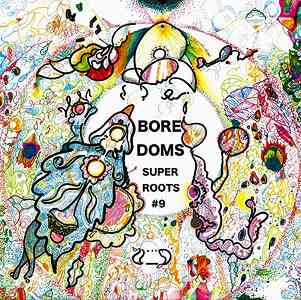
We will do this by posting Super Roots 9 by the Boredoms. In which the Boredoms' ecstatic polyrhythmic assault is joined by the wordless vocals of a large choir, a choir so eminently talented and precise it really sounds like a mellotron, or other amusingly old piece of sampling technology. An afro-Scriabin vibe predominates.

It has been brought to our attention that we are perhaps a few weeks or so behind in posting this, that any good boredomian has most likely procured it by now.

The intention of AC is not to be the first place to go for music. Or the best place. The intention of AC is to be a strange place to go for music.

One key editorial policy here is the well-known maxim from Hegel: The owl of Minerva flies at dusk. This owl, whose trajectory mirrors that of Understanding, has to wait until all the wildness is over, until shadowy calmness has begun to spread, before it can take flight.

So while you may already have Super Roots 9 by the Boredoms, there is a strong chance that you were not aware that it was recorded in a shopping mall. In Harajuku. And that this shopping mall is called LaForet, and that it is a very advanced shopping mall. This should be evident by the fact that: the Boredoms recorded Super Roots 9 there. In Japan, this is not even a big deal. If Sonic Youth went and recorded at one of the overweeded, abandoned shopping facilities that now litter midwest America in a very Dawn of the Dead fashion, it would be conceptual art.

LaForet, Harajuku, Tokyo


LaForet has several gallery/museum spaces built into it. For example, when I was there, Brian Eno was showing his newest work, "77 Million Paintings".

77 Million Paintings


LaForet often gets art director Nagi Noda to do campaigns for them. Noda's work is so surreally imaginative, one forgets that the Japanese don't even do drugs really. Can you imagine if they did? I don't want to think about it.


Not sure if it is clear from the image, but the idea is to have a model in a funny outfit and then have another model dressed as the cute, haunting shadow of the first.

Here's a Coca-Cola video she directed. It's not CGI. That's to say, it is a huge room full of actors standing perfectly still in imitation of a kind of Eadweard Muybridge early-photography stop-motion effect.

Muybridge's "The Horse in Motion"


And here is a video she did where poodles exercise. It follows the artistic logic of coming up with a bizarre premise, and then simply letting that premise run on a little too long. This is a highly effective strategy, as it makes the viewer begin to question whether it's not actually a real thing, a thing in the world, which goes on with not much point to it, as things in the world often do, as opposed to an elaborate art joke, which makes its point and then exits the stage.