Popular Post

DISCO MELTDOWNS


TANTRA - THE HILLS OF KATMANDU

On Monday I went to the Social Security office to apply for a replacement SS card. Don't ask, but believe me, because I would not lie to you, after all you've done for me, sometimes without even knowing that you did so, which can be the most beautiful way to do things, with that soft warm light of self-oblivion, the kind that will come to shine again in the end of days.

It should come as no surprise when I tell you that there was a despicable, soul-crushing line awaiting me, and that I waited there, in the queue in that airless room with other crushed souls, for a good hour, and that I listened to music, and that I had to stop listening to these songs that I'm sharing with you, because they were way, way too amped up. I literally felt like I had to start running around, so I put on "El Kinto" instead, a highly peaceable antidote.

This is my way of saying please don't listen to these tracks while you in a physically constrained environment, because you will probably want to start moving your parts around in a rhythmic way. Best to go running, or jump on your bed, or dance. Both are highly recommended in general, both are specifically highly recommended as workout anthems, and both will be soon played by me in a DJ or DJ-like environment.

TANTRA - HILLS OF KATMANDU is a severely holy-shit epic italo-disco classic, recorded by Celso Valli, who is another legendary Giorgio Moroder type. It is a brawny, barebones dance comet, it has girl singers, random 80s guitar riff interventions, and flute solos. It's from the early '80s. If you want to know where LCD Soundsystem came from, guess what, it's this stuff - a solid grail of deep underground disco. Why is this not on CD? I guess because if it was, it would kill the 'holy shit' factor you get when you hear it for the first time, after you think you're a big enough nerd to have heard all great underground disco already (you're not not by a long shot. thankfully).
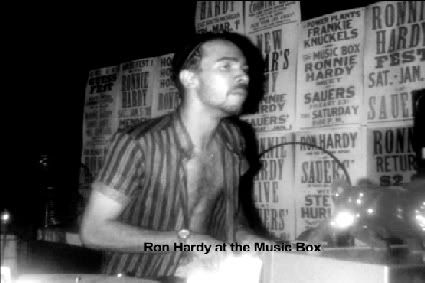


RON HARDY @ The Music Box in Chicago, early 80s

This Ron Hardy edit of ISAAC HAYES - I CAN'T TURN AROUND is also fire, hellfire, like melt the house down fire. Because it's nine minutes of a jacked-up horn-section dominated funk groove with Isaac over the top. It just smells like furious sweat. Every time you go to dancing in a club, you should have to thank Ron Hardy for it. You should have to touch your fingers to one of those little things by the door frame like the one that you touch if you're Jewish. Also what's great about edits like this is the man-machine hybrid: it's not drum-machine and computer beats, it's people playing, but they've been caught in Hardy's time-warp loop device and they can never escape, they can just churn out peak-time burners like this into infinity.

The Devil, The Author, and The Red Right Hand


BEN STILLER IS NICK CAVE
 

I had the chance to see Nick Cave last night, along with several Bad Seeds. It was by turns aggressive, cathartic, confessional, incantatory. An invigorating performer and consummate showman ("What? No, we can't play that song. Too gloomy. So this next one is about a guy going to the electric chair..")

Cave has an exceptional understanding of all the different points that intersect in being a rock singer - how you're a priest, a magician, a lover, a storyteller, a healer, a vampire, a demon, all at the same time. This kind of shapeshifting energy is the subject of one of his most well-known songs, "Red Right Hand," which warns of a diabolical shadowy figure who operates traceless and sinister, and who's kind of a substitute Satan without being named as such. 

It's a character not unlike the one at the center of Stephen King's Needful Things, who opens up a store in a small town for the sake of carrying out all manner of Faustian bargains with the townspeople - he's got IT, that thing you need the most, for a price, etc. 


Now it should be asked, what is the artistic obsession with the devil, with devil-like or diabolical characters? Because, to put it simply, every artist is the devil. Artistic creation is always creatio ex nihilo, and every creative act challenges God's monopoly on creating. 

Furthermore, what binds the artist and the devil together is that the artistic act, like any act of Lucifer, the fallen angel, is ultimately born of a power inferior to God's. The artist loves the devil because it's both their job not to replace the world of God, but to screw it up, to make trouble, to negate, to intervene. 

There is a hole in the world, the world that God made, because there is a hole in God. This is the Gnostic interpretation, the kind that the institutions of Judeo-Christianity had to fight to contain throughout history. The artist goes to this hole and he picks at it like an eternal wound, and from there he makes new things for the world, out of this hole. Where else do you imagine new things come from? 

Finally, when art dreams of demons, this is because it is thinking about its own origins, because it is reflecting on how it is born of what psychoanalysis calls the drive, the compulsion to repeat, the de-stablizing, addictive urge, of great power that consumes the one who undergoes it, who draws the artist in beyond his self-control.

The red right hand that Nick Cave sings about, that is the hand that holds the pen, that is the hand that is splattered with paint, it is the artist's own hand.

Another song that Nick sang last night was called "We Call Upon the Author to Explain," and its lyrics are a list of unjust suffering, contingent abuses, unexplainable sorrow, and the author is of course in this context God, whom you can call upon all you like but will not answer you. If God wanted to ever answer you, there would be no need for Nick to have a song about it. 

I could not help but think as well of David Foster Wallace, the brilliant, exceptionally-talented novelist, one of the best of his generation, who recently took his own life - one whose writings so often faced hopelessness and despair with rare courage, I could not help but want to call upon him as well to explain, to explain why after all this it seemed that his own words had failed him. What use, I wanted to know, was writing after all, if it could not keep you alive?